
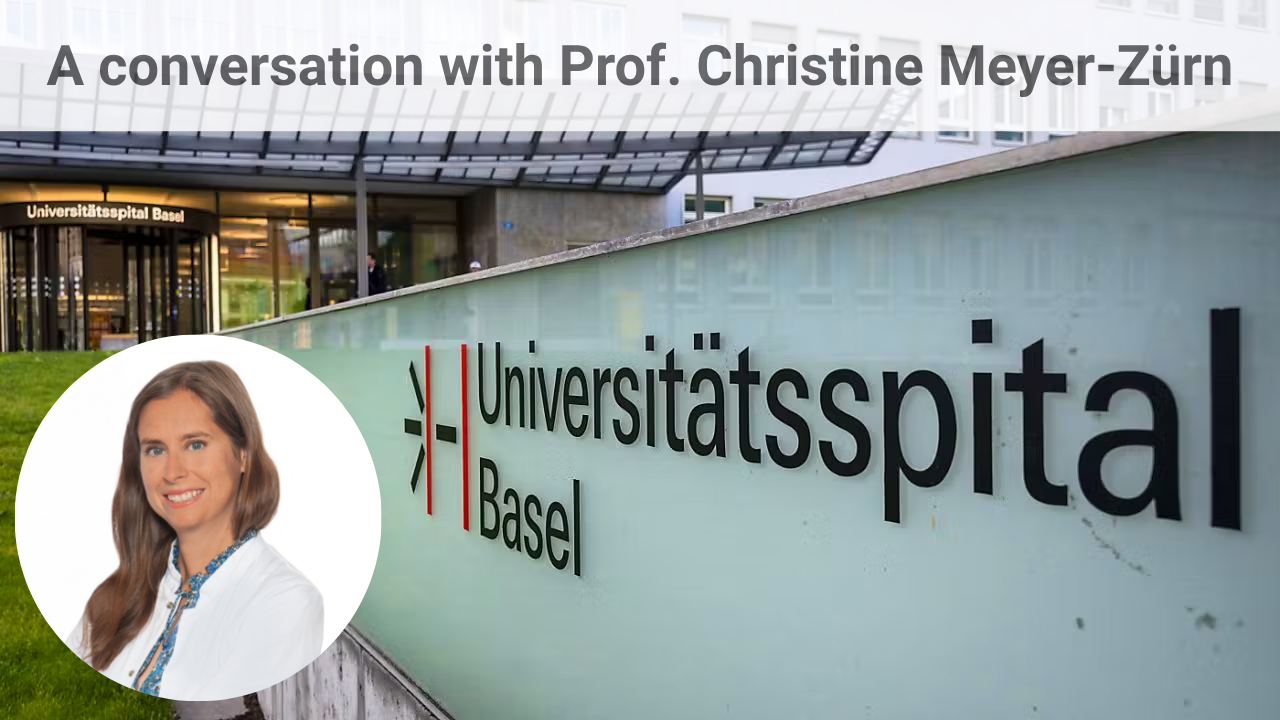
We recently sat down with Prof. Christine Meyer-Zürn from University Hospital Basel to reflect on our long-standing collaboration and discuss the evolving landscape of ECG research and artificial intelligence in cardiology.
Rafal Samborski: This is already our sixth joint project. What makes USB continue coming back to collaborate with Cardiomatics?
Christine Meyer-Zürn: Our continued collaboration is largely based on consistent methodological quality and reliable ECG analytics across several joint research projects. In multiple studies, including the Swiss-AF Burden cohort, the AI-based atrial fibrillation burden quantification demonstrated very high agreement with physician-adjudicated assessments. This level of concordance supports its suitability for further use in clinical research settings.
What are the biggest methodological challenges in ECG research today, and how can collaboration with technology partners help address them?
Modern studies increasingly rely on prolonged monitoring (e.g., 7-day Holter or longer), generating massive datasets. Manual adjudication is time-consuming, resource-intensive, and subject to inter-observer variability. Ensuring consistent and scalable analysis without compromising accuracy remains a central challenge.
Ambulatory ECG recordings frequently contain artifacts, motion-related disturbances, and variable signal quality. Robust preprocessing and reliable arrhythmia discrimination are essential to avoid systematic bias. AI-based platforms can provide automated, standarized, and reproducible quantification of arrhythmia metrics.
How do you see the future of long-term ECG analysis and the role of AI in cardiology?
Historically, ECG analysis focused on binary event detection (e.g., presence or absence of AF). Increasingly, attention is shifting toward quantitative phenotyping—such as AF burden, temporal variability, circadian patterns, and arrhythmia dynamics. AI is uniquely suited to extract these high-dimensional features from continuous recordings. The post-ablation setting is also a particularly attractive application for AI, also to detect sex-differences, which we are currently focusing on.
AI-derived ECG metrics will likely become integrated into multimodal risk prediction frameworks that combine imaging, biomarkers, genomics, and clinical variables. Importantly, AI should be conceptualized as a tool for augmentation rather than substitution of clinical expertise. Automated ECG analysis can reduce workload, enhance consistency, and allow physicians to focus on interpretation and clinical integration rather than primary annotation.
However, rigorous prospective validation, regulatory oversight, ethical considerations and transparent reporting standards will remain essential to ensure clinical safety and scientific credibility.
A key next step is the structured transfer of AI applications from predominantly scientific use into routine clinical practice. This transition must occur with continued scientific oversight and involvement of physicians to ensure methodological rigor, patient safety, and clinical relevance.
This year, the ESC Digital and AI Summit 2026 will be held in Basel and will provide an important platform to advance the integration of digital technologies and artificial intelligence into cardiovascular medicine. The focus is not only on algorithms and technical architectures, but also on data quality, validation strategies, workflow integration, and measurable real-world impact.
The overarching goal is to co-design trustworthy and explainable AI solutions that clinicians can confidently apply in routine care, that patients genuinely benefit from, and that healthcare systems can responsibly implement. By connecting technological innovation with clearly defined clinical needs, generating robust evidence, and fostering interdisciplinary collaboration, a sustainable and responsible digital transformation in cardiovascular care is becoming a reality.